Tuesday, February 1, 2022

Setting up maths success 2022

 Explore the links on the first page 

NZ maths have problem solving part 

Oral language driving the math 

There are different ways to explore maths in a very fun way. 

Ice cream colouring- compare - statistics 

Sorting Emoji pictures 

Growth Mindset 

Problem solving and basic maths to incorporate in your practice 

Sunday, January 23, 2022

Governance


Impact report: Legislation and colonisation

 Impact Report-Legislation and colonisation 


How legislation has negatively affected Māori society. 


Introduction 

The colonisation of New Zealand has affected Māori negatively and this was thought to be due to differences in cultural beliefs between the British settlers and Māori. In this report, I will present five pieces of legislation that have impacted Māori negatively. Those five pieces of legislation are New Zealand Constitution Act 1852, Public Works Land Act 1864, Native School Act 1867, Tohunga Suppression Act 1907, and Māori Trust Board Act 1955. I will describe each legislation along with the negative effects that caused for Māori. 


New Zealand Constitution Act 1852


This is the act that British Parliament passed as “an act to grant a representative constitution to the colony of New Zealand” in 1852 (Derby, n.d. Para 1). This brought the division of New Zealand into 6 provinces (Te Wānanga o Aotearoa, 2018).  Māori custom and law was supposed to be protected for ‘Māori districts’ under Section 71 of this Act, but the crown never implemented this section (Te Wānanga o Aotearoa, 2018). It is important to understand that Māori was not thought about in the implementation of this type of law, and that it did not consider the system of Māori law and the way Maori settled disputes (Te Wānanga o Aotearoa, 2018).


Public Works Land Act 1864 


This Act meant that any lands needed for constructing roads, railways and other public works were taken by the Crown without compensation (Te Wānanga o Aotearoa, 2018). This caused issues, for example, some land did not meet its purpose to use as it was originally suggested and the land was not returned in most of the time (Te Wānanga o Aotearoa, 2018). More Maori land was used compared to Pākeha land when roads often go through land owned by Māori and they did not receive compensation for that (Te Wānanga o Aotearoa, 2018). 


Native School Act 1867 


Native Schools were built within Māori communities under this Act and only English was used as the medium of instruction and these schools were going to expand once English became the primary language in the communities of Māori (Te Wānanga o Aotearoa, 2018).  A number of the Maori generations have experienced physical punishment for speaking Māori at school or in the playground (Te Wānanga o Aotearoa, 2018). The Native Schools Act has affected negatively for Māori on the use of te reo Māori and this has subsequently caused a loss of the language and English was used as the first language at home (Te Wānanga o Aotearoa, 2018).


Tohunga Suppression Act 1907 


This act was established because of concern for tohunga practices that were deceitful (Te Wānanga o Aotearoa, 2018). A large number of self-claimed tohunga appeared without the appropriate training  (Te Wānanga o Aotearoa, 2018). Although this act was barely made use of and only a small number of convictions were made, Māori communities were affected by this act profoundly (Te Wānanga o Aotearoa, 2018). This meant that the role of tohunga damaged the way they connect to the spiritual world which influenced Māori society (Te Wānanga o Aotearoa, 2018). The number of tohunga decreased and almost no authentic tohunga are practicing now and The Tohunga Act was revoked in 1962.  (Te Wānanga o Aotearoa, 2018). 


Māori Trust Board Act 1955 


According to Te Puni Kōkiri: Realising Māori Potential (2018), “Māori Trust Board Act provides the legal framework within which Māori Trust Boards operate and gives the Minister for Māori Development (the Minister) specific powers to enable Ministerial oversight of the affairs of Māori Trust Boards” (p.5). The Crown had the control over the Trust Boards in making final decisions about the finances, land, purchased resources and their management (Te Wānanga o Aotearoa, 2018). The Māori Trust Board Act impacted hugely on the social structure of traditional Māori resulting in iwi facing political and economical influence by the act (Te Wānanga o Aotearoa, 2018). This meant that the Crown did not have to deal with a number of Māori entities as there were less iwi than hapu. (Te Wānanga o Aotearoa, 2018). 


Conclusion 

In conclusion, Māori society and people were negatively affected by the colonisation of New Zealand and the cultural differences between Māori and the British settlers. In this report, five pieces of legislation including, New Zealand Constitution Act 1852, Public Works Land Act 1864, Native School Act 1867, Tohunga Suppression Act 1907, and Māori Trust Board Act 1955 were described along with its negative effects on Māori. It is clear that colonisation and the legislation that came with it has damaged the traditional Māori practices and Māori people’s identity, and the legislation that was discussed here brought social demise on Māori. 


References 


Derby, M. (n.d.). Ngā take Māori – government policy and Māori - A new colony 1840s to 1850s , Te Arathe Encyclopedia of New Zealand. Retrieved June 26, 2021 from http://www.TeAra.govt.nz/en/document/34377/constitution-act-1852


Te Puni Kōkiri: Realising Māori Potential (2018). The Māori Trust Boards Act 1955: A practical guide for members and beneficiaries of Māori Trust Boards. Retrieved June 26, 2021 from file:///Users/yakasaka/Downloads/tpk-maoritrustboardsguide-2018%20(1).pdf


Te Wānanga o Aotearoa. (2018). Study Guide, Mana Tangata: He Tikanga Whakaaro. Te Awamutu, New Zealand: Te Wānanga o Aotearoa.


Reading What happened to you?, Notes about early trauma


Sunday, June 27, 2021

Maths Made Easy

 Maths Made Easy         Marie Hirst and Jo Knox 


The primetime to focus is in the beginning of the lesson. Fun maths, fluency maths. Reflecting what they learnt today before leaving in the end of the lesson. 

Purpose 

Activities for everyone 

Rather than speed and focus on thinking

Short snap shot 

The right level of challenge

Can be adapted for other levels or maths focus 

Minimal equipment 

Reasoning, Fluency (not speed automaticity), Maintenance, Engagement 


Estimate 

What do we think is too low? or high? 

Estimation clipboard- Slides to download  

Toytheater 100 chart 

Esti-Mystery 

Go through many clues to find the answer 

Calendar Maths 

How many concepts are covered in just 4 minutes? 

Counting how many days we have been at school 

Tallys ( whos lost a tooth?) 

Days of the week yesterday, today, tomorrow 

Daily Maths Wall -make a wall with a whiteboard 

Show it 

Make the numbers 

Odd or Even -can share it between 2 if it was even 

How do you write 26 in words? 

Place it on a number line?

One more and One less 

10 more and 10 less 

Number sentences- how many ways can you make it? 

Doubles, 3 numbers, multiplications, fractions to make the num 26 

Half it, Double it 

Pyramid 


Mystery I spy 
A number more than .....5 using cards 
less than
in between 

two numbers that have a sum of 
difference of
Product of 


Odd one out 


Countdown, Number game from mathsstarters 

3,2,1 Salute! 
Bonds to 5, 10, 
Putting thumbs up when knowing the answer 

Maze Steve Whyborney 

Splat! 


Hand Game
Adding, Subtraction, Multiplication 
Collaborative way 


Thursday, January 21, 2021

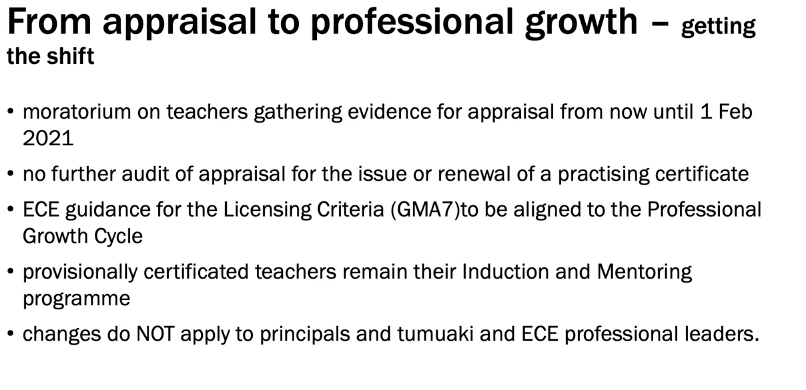
Professional Growth Cycle- How the system of appraisals has changed

 What we are really good at already 

Working in a dynamic context 


Professional Growth Cycle 

Developing leadership in teachers 

Personalised professional learning 

Not expected to access professional development


Appraisal to professional growth 

Evidence that is naturally occurring 


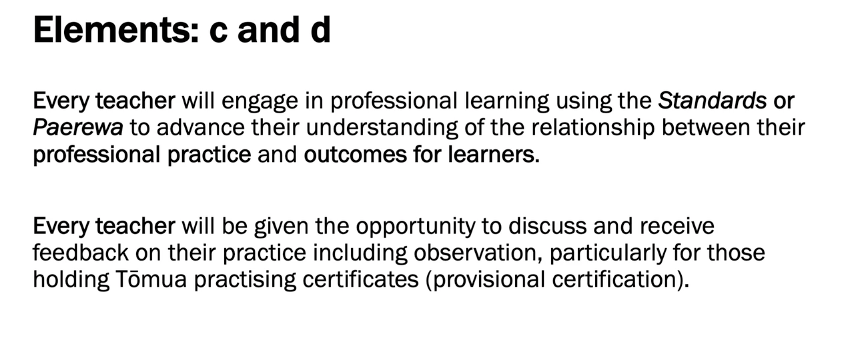
6 Elements 

You and your teachers, what do you know have helped your teachers? What difference were made  for learners?


New thinking, innovations and solutions 

Discuss and receive feedback 


Amount of the observations are not prescribed 


 Collecting naturally occurring evidence 

System to support new learning 

Empower colleague to do observations 


Professional growth cycle is Everyday teaching practice 

Foster collaborative learning 

Understanding standards, Paerewa 


Important page to visit 


Meaningful literacy and maths experiences in play

 Knowing the child,  group setting, feeling insecure about reading in front of others 


The layout of the classroom: where you put your toys and equipment 


Routines/Setting up your space 


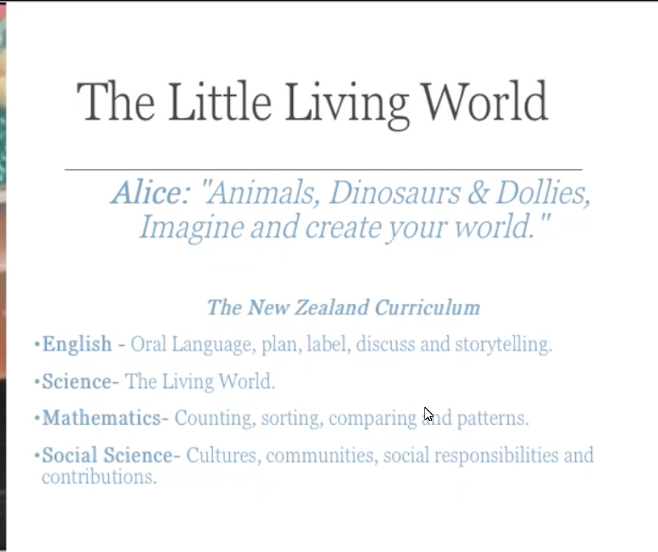
The little living world 

Animals, dinosaurs›, dollies

Imagine and create your world 


Placemats, cushion covers, books about specific learning 

Mix and pour places 


Maths 

Carparks 

Tidying up in a mathematical way (tall blocks, short, shapes) 

Baskets of maths 

Number candles 


Little ideas

Number of the day

Child’s wonderings 


Mat time- fun and exciting, taking mat time to places that are the children’s interests 


Literacy 


Children’s drawings and linking to the curriculum (English) 


Arts and literacy are married in some way 

Using loose parts 


Purpose/Audience/organisation/language 


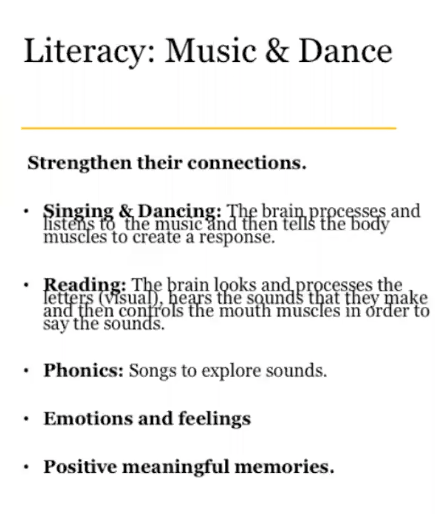
Music and Dance 

Music is a language itself. 

When you compare singing and reading, there is not much difference 

Dancing-gross and fine motor skills 

Dramatic play area 

Loose fabric 

Sunglasses

Headbands

Baskets

Shoes 

Accessaries 


Stepping into the story 

Tiger who came to tea 


Range of writing tools, thick crayons, chalk, stamps, large paintbrushes 

Envelopes, large pieces of paper, whiteboards 


Wednesday, January 20, 2021

Play Therapy

 Empowering the child, and the child will have some strategies 

A method of helping children with behaviour and emotional problems to help themselves. 

Play is the child’s natural medium of self expression.

Therapeutic 


Goodman’s strengths and difficulties questionnaire 

Retest at 8 weeks, and review and what the next steps are. 

Pro social scores go up 


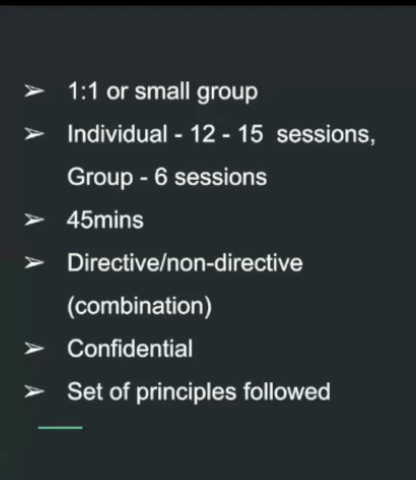
45 minutes 

5 minutes left (visuals) 

1 minute left and 10 seconds (what were the urgencies before finishing?) 


Social coaching in a group as well 


Picture books 

The colour monster 

Hay warrior 

Let it go 


Relaxations 

Finger breathing: Slow controlled breath 

Straw and water in a glass 


Area of the toolkit 

Puppets 

Different types of puppets, animals, people 


How do we find play therapists? 


Longworth Education Conference: Teaching literacy through play

 Developing literacy through play: creating invitations and story tables by Linda Cheer 


Giving our time, slowing things down, take the time to have fun 


Joyful Reading/writing 

Social learning theory

Not about how we teach, but how we learn 

Constructing from inside 


What knowledge does the child already have that we can build upon 

They are not recipients of knowledge 


Literacy teaching is more than just doing group teaching. 


Shared reading

Shared writing 

More time on developing their oral language 

Gift language and facilitate new experiences 


Signs: go, stop, arrows 

Clipboards and pens 

Whiteboards 


Writing tools and loose parts 

Vocab cards 


Reading to myself 

Talking about pictures and sharing their experiences 

Writing in shaving cream 

Paintbrushes and water 

3B1 notebooks 


Dramatic play in the classroom 


Story tables with different things with a picture book. 


Koala would couldn’t 

The tunnel by Anthony Browne 

You can do it Bert 

Stuck 


Tuesday, January 19, 2021

Longworth Education Conference: Encouraging the potential of our tauira

 Encouraging the potential of our tauira by Tammy Nepata-Gibbs 


Whare waanaga 

A book called Decolonising maori myths 


Thinking about classroom set up 


Our ways of doing things are the way we need to teach our children 


Multiple intelligences 

Children bringing their gifts to the classroom


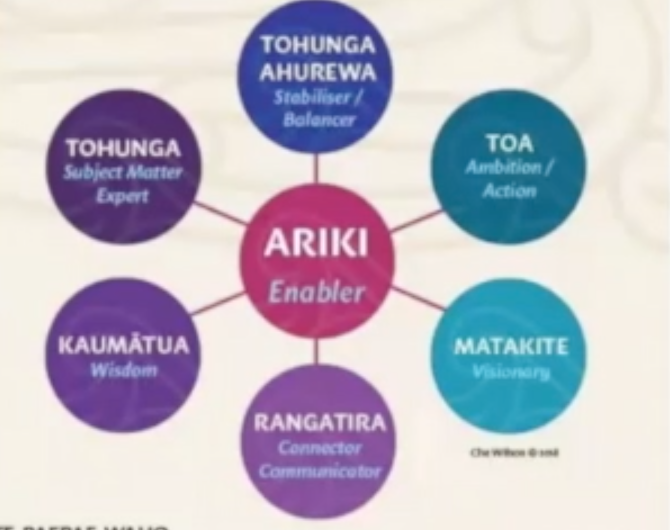
Ariki as enablers 


Children were chosen to go to a specific whare 

Knowing what urges are in play 

Skills that we see in our children 

Build on the skills that they already show 


Seeing children of what the children can do 


Observe and build on the skills -appreciative view 


Pūwaiwaha of the classroom 

Multiple pūwaiwaha opportunities 

Think of open ended abilities throughout the curriculum areas 

The single answer to creating multiple ways 


What is my song? Dennis Linn 


Hangarau Technology for children in all aspects 

So many other ways to carry our knowledge, our arts to communicate 


Tukutuku

Moko

Tāmoko 

Kowhaiwhai 

Karakia 

Waiata 


Opportunities to use resources that they can use and manipulate 


Te reo Māori/Tikanga Māori 

Gift them language while they do what they love 


Feeding them the language 

Commenting on what they are doing 


Using te reo through play 

They have a place, purpose 

Teaching Tikanga through play 

Tiaki te mahunga. Look after the head. 


Corrections of Tikanga 


The purpose of knowledge is to pass it on 

You give knowledge and take knowledge 


Longworth Education Conference: Transition to school

 Transition to School by Jill Skkjottrup


Links between Te Whaariki and NZ curriculum 


Constructivism 

Social and cultural experiences, children develop their knowledge through experiences 


Importance of relationships 


Relationship with the teacher, whanau, peers 

Knowing the child and getting to know the family 


Emotional security between a teacher and the children affects how the children play  


A sense of belonging 

How do we know that the child is the heart of the matter? 

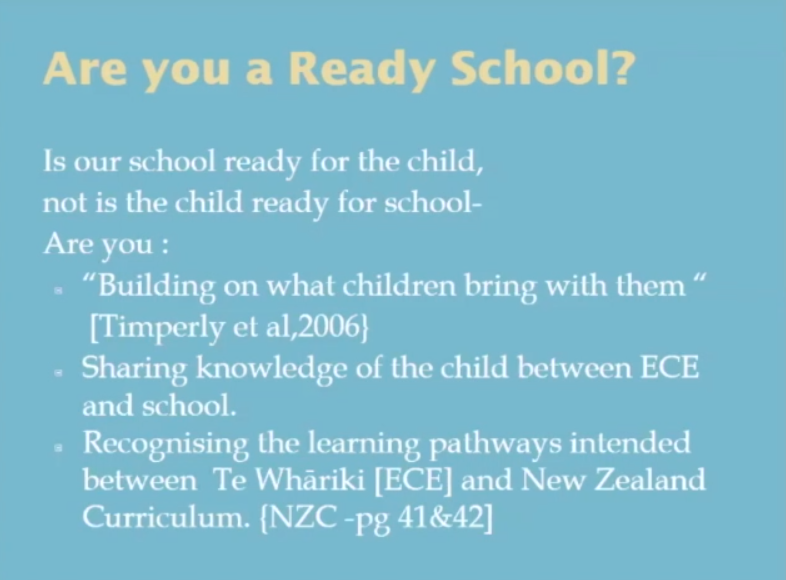
P42 NZ curriculum - intended link between the curriculum and Te Whaariki 

Linking to Level 1 

This is why we are doing it, we know that there is a smooth link between the two curriculums. 


Are you a ready school? 

Find out about the learner 

What the learner brings to the environment 


Environment as the 3rd teacher 

The child is the first teacher, being creative, experimenting 


Being ready for the child 


Sheets, ropes, and pegs 


Piaget theory- developmental stages 

Natural resources 

Foster imagination 


Three Ps 

Play, Pocket, Planet 

Do they connect to nature in the environment? 

It is the process that is important not the product 


Do children have access to the equipment? 


Outside environment 


Woodwork table, water trough on the deck 


How often do you allow your children outside? 

What are the barriers at your school and how can you overcome them? 


Why do some students find transitions so difficult? 


Longworth Education conference: Ready 4 Learning presentation

 Presented by Andrea Ford and Carolynn Masson 

Ready for Learning 


Key foundation skills necessary 


Hearing

Speaking

Seeing 

Print 

Moving 

Key Competencies 


Developing Automaticity 

So not taking up any space in their brain 


 Cognitive overload can happen when children have not developed automaticity in their foundation skills 


Moving

Fine motor skills 

Lots of opportunities- playdough, ripping

Gross motor skills-crossing midline, jumping, balancing, skipping, hopping 

Balance- core stability- important for learning 

Crossing Midline- zip up school bags, putting shoes on 

Tripod hold 

Palmar grip 

Deliberately teach how to hold a pencil 


Change before 7 to hold a pencil otherwise it will be permanent 


Crossing midline activities- drawing figure 8 with one hand, obstacle course, hopscotch, playing at the playground, cutting with scissors, threading 


Speaking 


Modeling by a child who has good oral language 

Feeding the language that the children need when talking 

Learning through a play environment provides great opportunities to develop oral language 

Refer to the book 


Hearing 

Being able to hear environmental sounds around them is important before learning phonics 

Rhyming, hearing the rhythm, being read to in the classroom and home 

Working memory 

3 instructions and being able to follow them 

Movement video-Go noodles, Picking up objects, naming them, rhyming activities


Seeing 

Visual discriminations - being able to discriminate visuals

Visual memory- hold an image and know what the difference is  


What the children can discriminate or not 

Puzzles, dominos, matching objects, making patterns 


Print 

How often we expose print to the children 

Concepts of print-explicit teaching- reading to the children, children were understanding the importance of this 

Read and feed - reading while the children are eating 


Connecting to key competencies-- teaching sharing, kindness, eye spy 


NZ Key Competencies 

Managing self and Relating to others 


Setting up maths success 2022

 Explore the links on the first page  NZ maths have problem solving part  Oral language driving the math  There are different ways to explor...