Showing posts with label #Teaching*. Show all posts

Tuesday, January 19, 2021

Longworth Education Conference: Transition to school

 Transition to School by Jill Skkjottrup


Links between Te Whaariki and NZ curriculum 


Constructivism 

Social and cultural experiences, children develop their knowledge through experiences 


Importance of relationships 


Relationship with the teacher, whanau, peers 

Knowing the child and getting to know the family 


Emotional security between a teacher and the children affects how the children play  


A sense of belonging 

How do we know that the child is the heart of the matter? 

P42 NZ curriculum - intended link between the curriculum and Te Whaariki 

Linking to Level 1 

This is why we are doing it, we know that there is a smooth link between the two curriculums. 


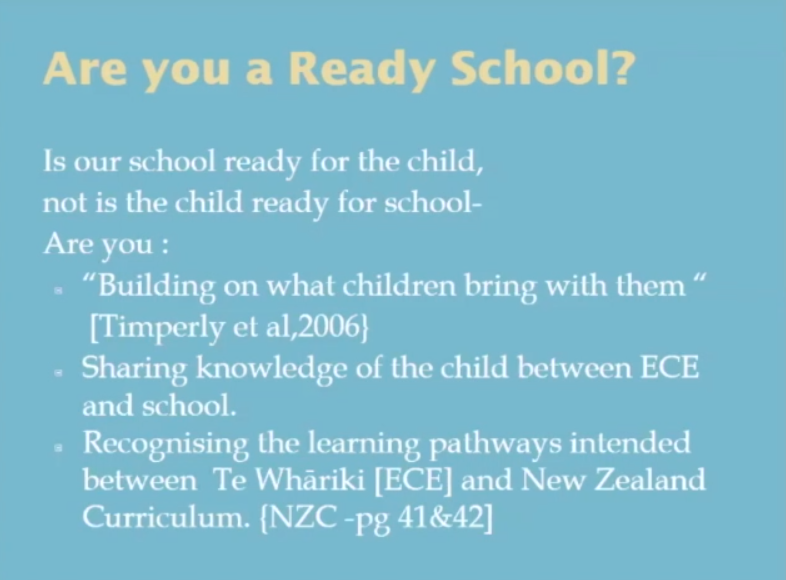
Are you a ready school? 

Find out about the learner 

What the learner brings to the environment 


Environment as the 3rd teacher 

The child is the first teacher, being creative, experimenting 


Being ready for the child 


Sheets, ropes, and pegs 


Piaget theory- developmental stages 

Natural resources 

Foster imagination 


Three Ps 

Play, Pocket, Planet 

Do they connect to nature in the environment? 

It is the process that is important not the product 


Do children have access to the equipment? 


Outside environment 


Woodwork table, water trough on the deck 


How often do you allow your children outside? 

What are the barriers at your school and how can you overcome them? 


Why do some students find transitions so difficult? 


Thursday, August 20, 2020

Altogether Autism PL session

 Altogether Autism 

What is Autism? 

Life long condition, born with Autism, diagnosed at possibly 3, provide strategies does not have cure. Experiencing the world in a different way. 


ASD: Autism Spectrum Disorder 

Disorder: negative 

Takiwātanga: Maori way of explaining 

In my/his/her own time and space, positive maori view about Autism. 

Te Reo Hāpai: book written by Nā keri Opai 


Characteristics (Social communication, interaction, restriction/repetitive thinking, behaviour, Sensory) 

Don't really way high functioning/low functioning, more like on a spectrum 

uses levels 1-3 

We don't call it Aspergers, all under Autism. Depending who is diagnosing and what manual they are using. 

Girls- they mask it and they are diagnosed later than boys. Girls tend to imitate others' play. 

Around the teenage years, they can't mask it later. 

Focus on the strengths 

Executive Functioning 

Help to be organised, plan, remember instructions, understand complex or abstract concepts, deal with change. Working memory 

Calming down activity 

What does Anxiety look like? Avoid new situations, no friendships/relationships, Misunderstood and seen as 'difficult' 
Children indicating how they are feeling, and what colour they are now, and after intervention/calming down 


Meltdown or Tantrum 
Meltdown is a medical event. The person does not have control over the behaviour. They can hurt themselves or others. They wanna hide, don't want to be the centre of the attention. 

Meltdown Stages 
1-Build up: pacing, fidgeting -trying to cope with the stressors and anxiety 
(Intervene early, introduce a break,  safe calm down place, physical activities tearing paper, squeezing the ball, staying calm, don't touch the person) 
Meltdown strategies 
Protect everyone, use a few words, protect the child's mana, exit strategy, no power struggle 
Recovery (either catch it before happening or after) 
Relax, Reconnect, Reflect, Recharge, Re-prepare 

Talking to other children who are autistic about the incidents too so that they will feel connected again. 
Shutdown- a child doesn't  internalise it 

Draw pictures and let the child know the change or what is happening now and next 

Behaviour=Communication 
Form of communication. 

Helping them to be independent. If they can't get their needs met, and can't communicate, the behaviour happens. 
Can't -find out whys. Is there a stressor? Is there a need to meet him? Skill deficit? Does he know how to tidy up? 

Sensory-friendly environment 
Sensory sensitivity- can't focus on one sense 
Check the physical part first 

Vestibular: Sense of balance 
Proprioception: knowing where the body parts are in the space (Spatial Awareness) Body GPS 


Hypo- need more of that 
Hyper- too sensitive, need less of it 

Interoception: internal senses, something that is happening inside your body 
knowing how the body is feeling 
Becoming anxious- they don't make the link between feeling anxious and why it is happening/ what is making them feel like that 

Creating a sensory profile 
Stimming: repetitive body movements, movements of objects
To calm us down and soothe us 

Stigmatisation- does this matter? 
Need to give the same feeling 
Stimming -appropriate at any age 

Communication
Strategies for communication 

You have the person's attention
Avoid complicated instructions
Keep your language clear, polite
Allow them time to process 
Visual cues 
Have important conversations in a quiet area 
Profile books to communicate with other colleagues about the child 

Visuals
First and then visuals 
First(Less motivated) and then (Motivated activity)
Social Stories 
Transitions, individualized, simples sentences 
Going on a trip, new situations 

Video Self-modelling 
Around routines, transitions, new situations, learn a new skill, break it down to the step  


Friday, February 21, 2020

Inclusive practice: Using NZSL in the classroom

This year I have a girl who is deaf with cochlear implants in my class. One of my passions in teaching is to teach our children New Zealand Sign Language, and I have been learning NZSL for the last 5 years. Although I am not fluent in NZSL, I love learning this beautiful language.  For the last 6 weeks, I have had a private tutor and have been learning it properly again, and especially at being able to form a sentence in NZSL.

As the girl has cochlear implants and can hear with the device, she does not rely on using NZSL so much however she knows quite a lot of signing and her family would like her to develop more knowledge in NZSL so it has been great to work with the family and that I regularly sign in the classroom with the children.

Some of the changes I have made in my class are
Having a visual classroom schedule and have the pictures of the signs next to it. This also reminds me to sign if I forget a particular sign.
I also have a sign of the day so we can all learn different signs.


Other children have started to understand why I use sign with the girl and why I wear the microphone so she could hear. Now we are trialling using a microphone that children can hold so that she could hear if someone is talking in a class discussion.

After reading Ako article about NZSL in a classroom/school , I felt very inspired and that I agree that hearing children should be learning NZSL together with a child who is deaf. I always think that people who are deaf should have access to their language so that we could communicate with each other. The children in my class will learn many signs this year and this will help them understand how different we are and how unique we are to each other, and to help us communicate, NZSL is an important language to learn for everyone.

At the moment the children are learning to sign Te Aroha in sign and te reo Māori.  They love singing and learning new songs and I can see how the girl is very responsive when I use sign. She watches my sign and copies it. She also teaches me some signs that I don't know. It is truly the word of "Ako" where we learn from each other. She has a place in our classroom and has developed a great sense of belonging in our class.


Thursday, January 23, 2020

Developing phonological awareness

This year as we will have new children in the term, I thought I would do something differently about developing phonological awareness. Last year, I feel that I didn't spend a lot of time exploring the basic phonological awareness and Stage 1 so much as I focused on my inquiry as trying Yolanda's Stage 2.
As we get to know children, I will develop an understanding if they are able to differentiate sounds.  I want to spend some time exploring the components to develop phonological awareness such as sound discrimination, speech sound discrimination, alliteration, rhythm, sound breaks and rhyme. 

Here is the document that discusses developing phonological awareness. 

It is important that I provide various opportunities throughout the week, daily to explore sound discriminations and developing phonological awareness in a fun way. 


Saturday, November 30, 2019

Reflection on the science conference

Going to this science conference for 3 days with Edie has been very valuable and eye-opening experience. I really did not know what to expect for this conference and I feel that I have learnt so much about what science learning is about and what Edie has been trying to work on with the support from Royal Society Te Aparangi.

Sharing our science experience with others and listening to other people experiences have been really beneficial to understand how we can teach science and get the children to feel really excited and be engaged in the science experiences.

There were a lot of opportunities to discuss, share ideas and hear thought provoking ideas, and I really enjoyed this part. I like how Jen said about how teachers say that science is everywhere, but we as teachers have professional responsibilities to teach our children and that we need to know what we are about to teach.

Over the 3 days, I thought a lot about myself as a teacher, science teaching and science in our school. I have never really thought myself as a science person, someone who is really interested in science although I do have some interest areas like sustainability, insects and looking after our environment. If I really want my children to think like a scientist or act like a scientist, first of all, I need to establish their ideas about scientists. Then, we can establish and explore our ideas about scientist. When we know that we are all scientists and we all do what scientists do in our daily lives, I can then use the language like "I like the way you are thinking like a scientist!" Using words like observing, describing, and gathering data in my practice is also really important so that it is explicit teaching and they will understand what these actions mean. I feel that I know where I want to start from next year with my new group of children to explore science in a more explicit way.

Listening to Edie and sharing ideas with her has been so valuable and I have learnt so much from her for the last 3 days and have felt her passion in teaching science. I didn't know how much time and effort Edie has put in order to create the past unit plans. It was so great to work together to develop the next year's unit and we were very excited to share this with our group and get some feedback.


Saturday, June 15, 2019

Trying out Yolanda programme

After going to Yolanda's training. I really wanted this to be my inquiry to see how effective it will be for me and the children.
As I was waiting for the resources to arrive, I have found a good site for pictures with alphabets. I cut out just pictures to use for the Stage 2 programme.
I have gone through Yolanda's video and wrote down some steps of the Stage 2 and Stage 4 so that it will be easy for me to read as I go through the steps with the children.
Stage 1 and 2 
Stage 4 

So far I have been trying the stage 2 with the whole class and it is working really great. With my target children for the inquiry, I see them every week to see how much they have retained the letter sound knowledge.

I do feel that it makes children to feel successful as it is very achievable for the children. I felt that organising and managing the whiteboards/pens/eraser were a bit chaotic in the beginning, but I used Velcro to attach a pen and an eraser for each whiteboard and this seemed to work better so that I am not spending too much time giving out the items in the beginning.

I also feel that in the beginning, I needed the script for me to go through the steps of the Stage 2 properly but now I have done this for the last 2 weeks that I have felt more confident at doing the Yolanda programme.

Saturday, September 8, 2018

Supporting parents

Child A has been having a little bit of a difficult time at reading, I realised this when she started boking the book and playing with the pages as she read. Her reading was quite slow and I could not understand why she was trying to move the book so much. When I talked to our librarian, she said that it could be that the girl was trying to get her eyes to focus on the texts and maybe it could be that the texts seemed to move as she read. She suggested the child to have the eye test with an optometrist to see if there are any eye tracking or other issues.

The family confirmed that her daughter would need glasses after the eye test and was really grateful that they had found this out and could help their daughter. After she got glasses, it was amazing as she never moved the books like she used. She then explained to me that she could see the words more clearly with the glasses on but without them the words looked very small.

With the glasses on, we kept working at reading with her, but I still felt that something was not quite right as the girl would struggle to read words like "on" and  "like", the words that children would have learnt to read at the magenta level. Talking to the librarian again about the problem, she had given me some strategies to use with her. The great thing was that the girl has amazing letter-sound knowledge which helps her to read words letter by letter when she is not able to recognise a word.

Strategies that the librarian suggested was
to use a card that has an indent so that the child can focus on one word at a time when reading
to work on the sight word chart and read it every day (the recognition of the words needs to be instant)
The sight words can be practiced on different ways, we have been using windows to write on with a window marker which she really enjoys.
Her eyes are working really hard to focus so if she is getting tired at reading, a teacher/parent can read the next page so she can rest her eyes and read the page after.

I also had a time to sit with her mum to talk about these strategies so that we are doing the same things at home and school. The mum really appreciated the support that we are providing and recognises how individualised the support has been. She continues to say how the experience has been very different from the previous school that they were at and talked about the importance of play in the classroom and how happy the girl is at our school.

This all has been really positive and important to reflect on. Working as an early childhood teacher for the last 10 years, I know the importance of building relationships with whaanau. All children are different and we need to understand their unique individual needs so that we can support them. Involving parents in this case has been easy and it is wonderful that we are able to provide the same support at home and school.


Saturday, August 25, 2018

Learning NZSL alphabet with children

As a part of my teaching inquiry, I have been adapting the use of New Zealand Sign Language alphabets to increase my target group's letter identification knowledge. I developed a video where I am signing the alphabet incorporating the use of big alphabet butterfly cards. I play this video everyday in the morning to watch with the children and sign together.

With the target group, they would watch this video everyday on the Ipad accessing from the QR code that I developed. Sometimes, I found it easy for the children to access it on the desktop computers as they could hear better with the headphones.

I am quite surprised about the results that the children have developed through the use of NZSL alphabet.
Here is the data result


Student Name
Start Date
Baseline Data
End Date
End Point Data
Improvement
Comments
Child A
11/6
LD- 4
10/8
LD-17 Sign-14
13

Child B
11/6
LD-9
10/8
LD-17 Sign-2
8

Child C
11/6
LD-28
10/8
LD-45 Sign-39
17

Child D
11/6
LD-5


not collected the data yet 
Child E
11/6
LD- 21
10/8
LD-37 Sign-23
16


I am happy to say that there has been a significant increase in children's letter knowledge using the sign language alphabet and their actual development in letter signs. 

One of the main issues that some children face is that it is really hard to transfer this letter ID knowledge in reading or writing. I have been doing some work as a class using NZSL alphabet to emphasize how a word is made up of letters. 
When I am reading a big book of shared reading, and I see the word 'Cat', we talk about the letters C, A, and T in sign, and how the each letter makes sounds. When we put these sounds together, it makes the word 'Cat'. I think in general, there has been a better understanding on this as a classroom as after this discussion, some children go away and come back with the word they made. They are interested and are using their knowledge to explore. 

I would really like to see where it would go using this strategy in reading as well as some children find it really hard to look at the first letter of a word and sound it out. 

In writing, one of the target children has done really amazingly using the developed letter ID knowledge. The child was able to write down all the sounds he heard/sounded out and wrote a sentence on his own. This was his first time to do this. 

I really believe that there is a benefit in using the sign language alphabet. It provides visual support that children can rely on. Some of the letters of the alphabet resemble the shapes of the letters. We often talk about this. 

Using New Zealand Sign Language is beneficial for hearing children. Dr Sutherland from University of Canterbury talks about the benefits of bilingualism (spoken and visual languages) and describes its educational benefits, cognitive development, economic benefits, and growth of communities.

Our children have been learning New Zealand Sign Language since Term 1 and it has been amazing to watch them acquire a new language. The children feel really proud of using this language and understand why we use sign language. Using sign language also helps children develop their fine motor skills and planning of their movement which essentially links to cognitive development. 


Saturday, July 21, 2018

Using Seesaw as a way to develop relationships with whaanau

Date: 22nd/July/2018 Reflection: Using Seesaw as a way to communicate and build relationships with whanau

The What? A description of the incident/experience with just enough detail to support doing your “So what?” section. Description about who, what, why, when, where

Since we have adopted the use of Seesaw, the online portfolio, the response and the interactions with the whanau have been very high and positive. As I used something similar in the previous centre I worked at, I knew that this was going to make a great change in the way we build relationships with our whanau and let them know how much I know about their children as well as the fact that parents are now able to see what the children are learning at school. For the last few months, I have been encouraging all of the families to join Seesaw so that they can see the updates on what the children are doing. I have been talking about the Seesaw in the classroom, so that the children also understand how this is used by the families. Some children ask me to take photos of their creations, and send it to their family through Seesaw. I would really like the children to be doing this independently in the future. The great thing about Seesaw is that the app is on the family member’s phone so that the parents/family members will get the notifications as soon as I post an item. Some parents comment on posts which create relationship building as some families share stories about their children and interests. Family members who do not live in Hamilton and do not get to see the children often really value Seesaw so that they feel connected in the child’s lives and what he/she is learning/playing at school.

So what? This is the sense-making section that asks you to surface general meaning, significance, your position/viewpoint: actions; emotions (pre-during-post)

I really enjoy the use of Seesaw and how I can develop deep and meaningful relationships with the whanau. As the individual post is private, this opens a way to interact and it results in both us the parties developing each other’s knowledge about the child, I think that is the most wonderful thing about using Seesaw. It is a way to enhance my relationships with our whanau. It lets the whanau know how much I know about the child, and also it becomes a great platform to share new knowledge with the whanau. For example, as we endeavour the play based learning philosophy, it is important to share the significance of the play based using examples I see in my classroom, and talk about why this is important for children’s development. It becomes a platform to get to know each other among whanau and celebrate their children’s learning together.

Now what? This section makes connections from the experience/ incident to further actions. For example, what would you do differently/the same next time? How come? What are key points, lessons to share with your colleagues, network and/or group outside the network? (idea, product, process, concept?) how will you do this?

I will keep using Seesaw and aim to get all of the families to join the Seesaw. I only have a few more families to join. My next aim is for the children to be able to use the Seesaw from the Ipads. They will need to learn the process of scanning the code, and then taking photos, putting descriptions and uploading their post. This is something I would really like to work on with the children.

Saturday, May 12, 2018

Inclusive practice- valuing the importance of recognising a teacher's passions through collaboration

This week, I have been working quite hard at promoting the use of New Zealand Sign Language (NZSL) to celebrate NZSL week. Prior to this week, I thought about how I would celebrate this week with the children in my class as well as the school. I thought about an idea that each day of the week, a video of a child signing a basic sign will be shared with everyone at school through the use of  the 10am news doc. This way, everyone will have access to the information.

Our children are familiar with New Zealand Sign Language as I talk a lot about it and use it through songs. Having many children are ELL means that signs can help children understand and communicate. They know basic signs like 'eat', 'drink', and 'toilet'. Our children can sing a few songs like 'Te Aroha' and 'One call away' and we are practising 'Count on me'.

Once we filed a video of a child signing, I uploaded the video on our blog so people can go and have a look at it. This was also shared in the Hamilton East School Facebook page which was so fantastic to spread the awareness of the NZSL week and how important to learn one of the NZ's official languages.

The children were so engaged with this sign language learning, and they were eager to learn new signs. It was so great that each morning, we would show the signing video that we filmed the day before so that they know what sign we are learning, and it really empowered our children. I also talked about our blog and how people can go and have a look at the video. We had a comment on our blog, so reading the comment let our children know that there is audience of our blog.

On Thursday morning, we went to the gateway and sang and signed 'One call away' and filmed it and I again uploaded this on our blog and Pippa also uploaded it on the school's Facebook page. The response from parents, whānau, and teachers were just amazing.

On Friday morning, we have decided to do a little concert using NZSL on our deck. Many children and teachers turned up to watch our performance which our children did an amazing job of. They were just so excited about putting a concert on. What was more amazing was that the school's senior children also performed one song in NZSL.

So what does this experience tell me?

To watch all the senior children perform showed that they cared about what we were celebrating and the importance of learning this beautiful language. It showed me how much the leaders of the school valued my passions in learning and teaching NZSL with my class and school. It meant that we are able to practise inclusive practice by learning something new, valuing NZSL/deaf culture, and developing understanding that having access to this language enables to communicate with more people.
I also thought about what our children have learnt through these experiences, and I recognised how confident our children were at performing the song and how engaged and excited they were through the week. In fact, our children are so keen to learn all of the alphabet signs so that they can finger-spell their own names. I like that it has brought a purpose and an aim, and I have to say that our children have achieved so much by performing in front of so many people.

While listening to the senior children perform, it made me feel so grateful to be at this workplace where they value people's unique differences/needs. I feel that when we are able to do this, we are able to support them fully with appropriate support. To me, inclusive practice means knowing the differences between 'equality' and 'equity', and changing our environment to support the child's unique needs before changing the child.

I would just like to thank all the people who have helped me this week celebrate New Zealand Sign Language Week.


Friday, April 27, 2018

Since the last post about settling a child into the class

Since the last post about the child struggling to settle into the class, I am happy to say that he has transformed himself. It is almost like he is a different child now. He loves to come to school with a smile on his face and actually does not want to leave the class in the end of the day.

On the last day of the term, we sadly did not have an assembly, but I gave him a toolkit award for his developing independency, being able to manage himself in the classroom, and making friends.

During the term 1, I have developed some strategies to support him.

The first thing was it was important that his mum does not stay too long in the classroom so that it does not give him too much anticipation for him. When mum come to drop him off in the class, she says a simple goodbye, and a hug, and tells him that she will be back. Although he used to cry when mum left, but it did not take much time at all for him to engage in something.

I have made a book for him to take home. The book was consisted of things that he was doing at school. I had photos of him and simple sentences of what he was doing. I had one in the classroom so that he could have a look whenever he wanted.

With another teacher's suggestion, he brought a soft toy of a panda bear everyday. It was important that first he develops a sense of belonging in the classroom. When there is no sense of safety or security, children do not learn. I asked if he wanted to bring a small soft toy or something that belonged to his mum, he chose his item of the panda bear. It was really nice to see the panda bear always sitting next to him giving him emotional support everywhere.

One of the things that he struggled was coping during morning and lunch break. It must have been quite an overwhelming experience as a number of children play in the playground and the court. I made a chart of duty teachers as he kept asking who would be the duty teacher for a break/lunch break. I could see that he was worried about it so having a visual chart helped him cope with his anxiety and calm him down a little bit. He would hang out with a duty teacher rather than children, and it took a while until he made his own friends and started to play together. Thanks to all the children who have supported him settle into the classroom, it encouraged him to develop really good friendships with his friends.

When he first started, he would use words like "I can't do it", "I want you to stay here."  It seemed like he wanted all my attention, and he felt just uncomfortable or not able manage his feelings when he was doing thins on his own. I would tell him that I need to spend time with other children too, so I would come back in 5 minutes and have a look at what he is doing.

Now, he is able to work individually, and he spends a lot of time on a task that he was given to achieve high standard work.

A lot of efforts went into making such big changes in his life. Lots of practices of many things like coming to school, sitting on a mat, playing together, managing his belongings, working together, getting to know other people in the classroom, and trying something new.

I am so happy that he is now settled into the class, and I hope that he can support new children coming into our class next term.
We often talk about how it felt on the first day of school, we might feel scared, nervous, or shy, excited....whatever we felt, it is ok to feel that way, and we are all here to be kind and support each other.

Setting up maths success 2022

 Explore the links on the first page  NZ maths have problem solving part  Oral language driving the math  There are different ways to explor...