It has been a few months since I have attended the Yolanda Soryl phonics programme. Since the attendance of this course, I have changed my practice hugely, and I can see the progress that the children have been making since I started the phonics.
I have started off with the Stage 2 phonics. I really wanted to make sure that what I present to the children is as close as what Yolanda did, so I watched her videos and wrote down the important things that she said throughout the Stage 2 session. I printed this out so that I can always read this if I get lost while I was teaching. As I taught a sound everyday for over 2 weeks, I was feeling more comfortable and often I did not need the paper to guide me through. The children also became really good at managing themselves with the whiteboards and pens and just the process of the phonics sessions.
Those children who became very confident at Stage 2 and acquired most of the sounds have moved on to Stage 3 which was quite a short stage. I am currently doing the second group of Stage 3 as I felt that some children were not so confident at this stage and learning about the first and last sounds are quite hard to develop to understand.
Some of the children have moved onto Stage 4 which is where children learn to hear the middle sounds of the words. I really enjoy teaching Stage 4 as it gets more challenging and you can really see who is able to hear the middle sounds and who might have a hard time. I have a small group working through Stage 4 at the moment and is going really well. Writing a silly sentence in the end can get a bit hard for some children but I am able to take time with those children and support them.
For the past several weeks, once a week, I am teaching Stage 5 . This is for children who can hear most of the sounds in words and working on the mechanics of the spelling. I have children from the new entrants to Year 1 classes who are able to do this and this has been really fun working with various children who are really capable and enjoy that challenge.
Saturday, September 7, 2019

Saturday, June 15, 2019
Class paepae 2
Since we starting incorporating the class paepae into our morning routines, it has been going so wonderfully. The children understand this process and have become more confident about how the paepae is ran and what they need to say. As a part of papepae, children are learning to their mihi. It is a simple mihi to say their name and where they are from. Most of the children are very confident at saying their name using Ko.... ahau. We are learning to say where we are from using No....ahau.
Celebrating Matariki with whānau
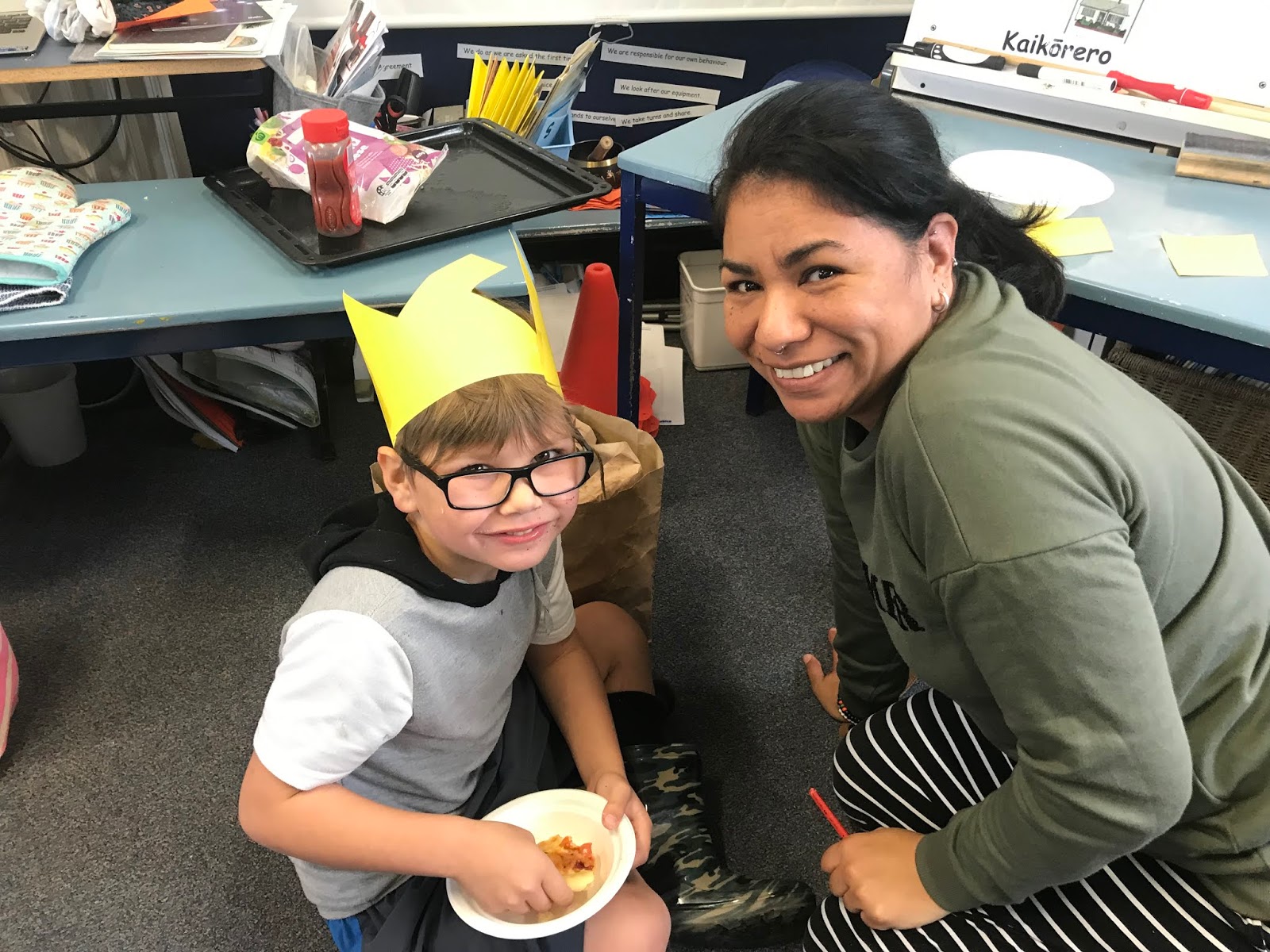
This year, we have celebrated Matariki together with our whānau. We made pizza and had shared kai. Many whanau brought a lot of food for us to share. It was so wonderful to be able to see our whanau, talk to them about their children and enjoy this time where we shared love for each other. We have read the book called "Matariki Breakfast" and from that children have learnt about what people do for Matariki and it is to spend time with the people we love.


I have asked parents to write down their aspirations for their children on a star shaped piece of paper. This allowed me to know what the parents thoughts and how they want their child to grow into the future. I also thought about including some of these into the report writing highlighting what types of dispositions they have developed over time.




Parents' aspirations
Trying out Yolanda programme
After going to Yolanda's training. I really wanted this to be my inquiry to see how effective it will be for me and the children.
As I was waiting for the resources to arrive, I have found a good site for pictures with alphabets. I cut out just pictures to use for the Stage 2 programme.
I have gone through Yolanda's video and wrote down some steps of the Stage 2 and Stage 4 so that it will be easy for me to read as I go through the steps with the children.
Stage 1 and 2
Stage 4
So far I have been trying the stage 2 with the whole class and it is working really great. With my target children for the inquiry, I see them every week to see how much they have retained the letter sound knowledge.
I do feel that it makes children to feel successful as it is very achievable for the children. I felt that organising and managing the whiteboards/pens/eraser were a bit chaotic in the beginning, but I used Velcro to attach a pen and an eraser for each whiteboard and this seemed to work better so that I am not spending too much time giving out the items in the beginning.
I also feel that in the beginning, I needed the script for me to go through the steps of the Stage 2 properly but now I have done this for the last 2 weeks that I have felt more confident at doing the Yolanda programme.
As I was waiting for the resources to arrive, I have found a good site for pictures with alphabets. I cut out just pictures to use for the Stage 2 programme.
I have gone through Yolanda's video and wrote down some steps of the Stage 2 and Stage 4 so that it will be easy for me to read as I go through the steps with the children.
Stage 1 and 2
Stage 4
So far I have been trying the stage 2 with the whole class and it is working really great. With my target children for the inquiry, I see them every week to see how much they have retained the letter sound knowledge.
I do feel that it makes children to feel successful as it is very achievable for the children. I felt that organising and managing the whiteboards/pens/eraser were a bit chaotic in the beginning, but I used Velcro to attach a pen and an eraser for each whiteboard and this seemed to work better so that I am not spending too much time giving out the items in the beginning.
I also feel that in the beginning, I needed the script for me to go through the steps of the Stage 2 properly but now I have done this for the last 2 weeks that I have felt more confident at doing the Yolanda programme.
Saturday, May 25, 2019
Yolanda Soryl Phonics Training
How to teach phonics.
7 stages of phonics.
Page 14-61
Phonics:
Shinderbell
Blending the sounds -essential for reading
Segmentation-breaking down the sounds
Avoid writing, writing safe stories (they know how to write these), they dont know how to break the sounds
Blending and segmentation are really important
1, how to hear
Decode- make sense- read
Look at the word and know the word
Graphic knowledge -memorising the shape (h( sound) and is, his)
Phonics
Grammar
Word recognition and graphic knowledge
Context/meaning
Lowest reader - phonics knowledge
“Get the words” first step for comprehension
Grammar search light -reading their own writing, reread their own writing (checking what they are writing
Good writing re read , poor writers dont
Context-looking at the pictures/ rereading own writing/ does this make sense?
Best readers and writers (connecting levels)
Components of reading
Decoding
Comprehension
Fluency-reading and effortlessly (slow reader- losing meaning) Working hard at decoding-not getting the meaning. If they are able to read fluently they can attend to comprehension.
Look at the words and know just like that (brain training)
Brain activity
Good reader- left side of brain
Struggling reader- both sides
Phonics can turn the left side brain on
Our brains are not wired for reading
Dyslexia or learning needs-Genetic
Deficiency and lack of repetitions
Teach it again and again until we dont need to
“How my brain learns to read”
Teaching phonics makes a big difference later on in their life- reading
Boys- advantage to teach phonics, children with english as a second language
Hear them read out loud everyday.
Phonological awareness
Spoken language dev
Letter/sound knowledge
Importance of phonological awareness at school entry
2 sounds (stage 3)
3 sounds (Stage 4)
Stage 1
Stage 2 -they know the first sound (do they know the first sound? ) 6 weeks to teach it 1 week to test it and again
Stage 3 - last sound (one week to teach it)
Stage 4 -middle sound once (dont teach stage 4 twice) - blending and segmentation (confusion with vowels)
Stage 5 -how to hear in every sound in a word Diagraph- sh two letters for one sound (hands on the hip)
Digraph is not a sound (a way of spelling a phoneme)
Make sure they can hear every sound of a word to move onto 6
By one year after starting school (phonics is finished by then)
Stage 6-7 - Year 2 long/short vowels (2 years after school entry)
Play train
Late they
So many ways to write (8 ways to write)
Page 13- system -school needing to have one system
Use phonics and graphic knowledge and ticks
The child needs to be able to read it by themselves -structured approach
Stage 1
Little and often through out a day
1 Close eyes-what can you hear? (conversations about sounds -rain, dog barking) Tuning into sounds
Is it motorbike or truck? Teaching them to how to hear
Sound track game
Using instruments -bells/shakers 4, 6, 10 instruments Similar shaker sounds (sounds table set up) boxes with different things inside to shake
Ability to hear different sounds (feeling it in their tongue) moving tongue activity
“I say, you say”
Make animal sounds -fluency faster “On your marks” make them think faster
Naming children in the line
How quickly can they tell you, give it to them faster
Alliteration
“I say you say” “what did you hear?” holding hands with children with learning needs
Animalia (3 words)
Starts with g with a pointing finger
Reading aloud to children 5 times a day
Rhythm coping rhythm (children not able to hold structure) children giving it back differnetly
All the things we do in music/movement -phonological awareness
Ability to hear sound breaks (sylable break, clapping with sylables) 3 times (one, two, three)
(Overcoming dyslexia)
Before the guided reading clapping
Voice loud and clapping
Robot arms sounding out and finger to blend
Rhyme -hear and generate
Nursery rhymes (make handouts to parents) Good book of nursery rhymes
Some off by heart (choose 5)
Missing word in rhyme
I like rice, it is nice.
5 rhyming families (do it faster) rhyming strands (mat, rat, fat… ) can they generate?
Phonological awareness book
Start at Stage 2 and sprinkle Stage 1 (10 minutes extra phonological awareness) Little and often
Stage 2
Letter sounds/graphine
N m s long sounds
Revising with the children who forget
Revising on their own- and getting them to wordshark and steps “what is this sound? “ toileting, duty time, every hour show the card to get them to say the sound
Stepping in before failing- keep them in the class (write the letter on the back of their hands, pointing and say the sound)
Letter/alphabet cards
Side of the teachers are the lowest
Composition :Talk to the neighbours about what they want to write about -come up with one sentence
Holding structure: clapping hands and say the sentence (teacher writing down the sentence)
Tell the children to use the sounds and words
Tell me again your story (your story is …..)
Point to the word I use bluetac next to the word I 2 hands for writing
Game-sound first sound for game g g g g game, point to it and bluetac, full stop
And pictures next
Exactly the same next day
Everyday for 2 weeks (word by word support)
Taking the support away (giving her choices M or n?)
4 weeks later (pointing to the row of the alphabet)
One sentence everyday
Writing is your voice written down
The vowels
Practice with clapping three times combination of them
Maintenance (a e i o u strip) random order then without pictures free from the website
Copy the student say the sounds -have a look at the you tube video
Heavy duty letters
You have to go right to left so the children can do the the other way (video on site)
Smart kinds poem
Assessment
Letter name/sound/ the words start with the sound
Teach stage 2 and test
Stage 3
Nip flip grip pencil holding
Puppet fish-fit what is the sound he cant hear.if he is right give him a round of prouse
That is called the last sound
Using pictures
First phoneme - go back and revise
First sound, last sound, last sound with a puppet
Stage 4
Non sense words -decoding words best decoders
Get to the word the fastest way
Phoneming words
Fingers and blend after
Sounding and spelling
Grapheme is written form of phonemes Shock 3 always the same
Satage 4 words
Hog
Chop
Shock
Stage 5
Frog f r o g 4 dont need to teach the blends need to hear phonemes
Hear every sounds
Smack
Frog
Stage 6
Way 2 sounds ay
W eigh
2 sounds no matter what
Rocket
D augh t er
Phonics manual
Ask a 5 year old
Fluency
More time reading
Anyone reading aloud to them
Tuakana teina
As many opportunities for them to be reading out loud
Read faster
Train them to read faster
Stage 4-reading the cards faster
Read the funny sentence with expression
Letter cards
Word cards
Give your children opportunities to know what word it is
Stage 2 writing quickly (is my go) without thinking about it
Shared writing
Everybody writing
Children give the children what they can do, and teachers fills it in
What will I need? Question mark
Spelling
Take a word from a shared writing
Like touch each letter
Louder, whisper, write it on your palm, silently, sing it (L, I, K, E)
Close your eyes
Write it on your whiteboard
Stage 5 hearing every sound in a word
Get them into writing using the words they are learning
Go up a stage and revise with the previous stage
Hear every sound
Wh ck
Q u 2 phonemes (qu)
Stage 6-7 long volwes
Key words
Sunday, April 28, 2019
The neuroscience of self care
Putting yourself first-why you need to
Put yourself first-being calm
Keep yourself calm
Stress response
Red brain-lower brain
Upper brain cortex
Sandpaper brain concept-
acknowledging and setting yourself back
Reactive-------------------------Rational Empathic/logical---creative brain
Sandpaper-build resilience-let yourself reset (recognising this and responds to it)
Moments of red brain moments (red brain-friendly staff room)
We cannot sustain having green brain all the time.
Reset really early
Give yourself a break -it deosnt take much to be sandpapred
Stress response
Stressor-assess the situation-activates the stress response (fight/flight response) -irrational
Keeping ourselves alive at red brain
Some of the children live in that space all the time
Teachers need to stay at the green brain
Takes a long time to calm down once the stressor is activated
How do we calm the children down?
Children become highper vigilant
Fight/flight response dry mouth, breathing changes, sight and hearing sharpen, stomach purges heart beats faster, blood increase in large muscle of arms legs
Checking in-resetting
Perfect practice makes perfect
1 Identify what calms you down (walk, run, yoga)
2 Do that until you create a physical calm state in your body
3 Condition this moment
4 Practice practice practice
Breathing: Deep breathing
Pulling the rope down -activate our lungs- Teach our children to take a deep breath
Put yourself first-being calm
Keep yourself calm
Stress response
Red brain-lower brain
Upper brain cortex
Sandpaper brain concept-
acknowledging and setting yourself back
Reactive-------------------------Rational Empathic/logical---creative brain
Sandpaper-build resilience-let yourself reset (recognising this and responds to it)
Moments of red brain moments (red brain-friendly staff room)
We cannot sustain having green brain all the time.
Reset really early
Give yourself a break -it deosnt take much to be sandpapred
Stress response
Stressor-assess the situation-activates the stress response (fight/flight response) -irrational
Keeping ourselves alive at red brain
Some of the children live in that space all the time
Teachers need to stay at the green brain
Takes a long time to calm down once the stressor is activated
How do we calm the children down?
Children become highper vigilant
Fight/flight response dry mouth, breathing changes, sight and hearing sharpen, stomach purges heart beats faster, blood increase in large muscle of arms legs
Checking in-resetting
Perfect practice makes perfect
1 Identify what calms you down (walk, run, yoga)
2 Do that until you create a physical calm state in your body
3 Condition this moment
4 Practice practice practice
Breathing: Deep breathing
Pulling the rope down -activate our lungs- Teach our children to take a deep breath
Wellbeing for teachers
Wellness
Relational teaching-emotional investment
"flow" Mihaly Csikszentmihalyi
Efficient-unstoppable-
Questions
Top 3-5 outside work activities you enjoy?
Is there an activity which you have left behind due to work?
What activities outside work and parenting define you?
Growth Mindset
S=strong
I=intelligent
C=creative
Strong: a part of wellbeing to engage our body -move for 30 min minimum
Intelligent: Creating a state of constant, inquiry, curiosity, learning (books, classes, Self authoring, language) Life long learners
Creative: cooking, music, drawing, painting...
Athletes/Artists achieve a flow state- faster and easier than others
Sense of balance
Try to tick 3 boxes when not at work
Create a behavioural pattern-bring your identity back
Relational teaching-emotional investment
"flow" Mihaly Csikszentmihalyi
Efficient-unstoppable-
Questions
Top 3-5 outside work activities you enjoy?
Is there an activity which you have left behind due to work?
What activities outside work and parenting define you?
Growth Mindset
S=strong
I=intelligent
C=creative
Strong: a part of wellbeing to engage our body -move for 30 min minimum
Intelligent: Creating a state of constant, inquiry, curiosity, learning (books, classes, Self authoring, language) Life long learners
Creative: cooking, music, drawing, painting...
Athletes/Artists achieve a flow state- faster and easier than others
Sense of balance
Try to tick 3 boxes when not at work
Create a behavioural pattern-bring your identity back
Subscribe to:
Posts (Atom)
-
 When we went to the Yolanda phonics course, she talked about a few books that might be helpful to understand how children develop phonologic...
 -
Article by Core Education Engaging junior learners and whānau at home
-
Since I have attended the webinar for writing through play, there has been a great change in children's attitudes towards writing. I fee...