Tuesday, November 26, 2019

Science teaching leadership programme

Science- taking time to take it in, observing, being able to describe what they see

Start with what we know before starting introducing a topic.

Science table: what would you have on the science tables?

OYLA magazines: Scanning, can be used for all the levels even though there are technological terms
When the teachers are engaged, the children are also feeling excited and get engaged.
Warehouse stationary: film canisters
Hands on things are really important for all children, but how do you engage parents and local communities? Inviting astronomy people come in and present a presentation.


Having a folder that we can have access to Edie's experiments?

Collaboration in science -working together to create a unit.

comparing data, challenging each other's findings

Science learning hub - great site to go and learn
Children go and research on their own- developing their wonderings?

Using the language of scientists
Teaching maths through the same topic

Blake inspire for teachers
Squawk squad

The electric garden: recording a process of planting/growing

Discussions: Covering all 5 contents (Nature of science, Living world, Planet earth and beyond, Physical world, Material world).


Authentic contexts-weaving other curriculums through, focusing on capabilities. not knowledge base? Hands on activities/experiences

Questions
Student/personalised learning (teacher manipulating the whole thing) be honest about it
Balance in depth: being able to notice what science looks like-varying capacities/knowlegde to do this: highlighting-is it really?
Formative assessments in the moment
Is Noticing once and making judgements? -depends on contexts
Rubrics -adults way to organise things- it is not evidence based

Unpacking about scientist: what do scientists do? What is science? How do scientists think? What do scientists look like?

This progression was from NMSSA report 17 Science 17 Key Findings 


Science in the New Zealand Curriculum 
Insight for teachers 


Scaffolding ideas about scientist
What are scientist? What do scientist do? look like? 
We are scientist, and we become scientist when we do... observing, gathering data,... 

Sand and diet coke experiment: rough parts- gas is caught in it Mentos has rough surfaces 
Microscopic of mentos on google- very rough around  


Thursday, October 31, 2019

Using more te reo in my practice

I was inspired by another teacher consciously  thinking about how much Maaori she was using in the classroom, I am making an effort to change my practice for the better and using more te reo in my practice.

I use te reo on the white board for the schedule. When I explain about the day to the children, I use te reo to describe as well as the English and NZSL.
I am also making conscious efforts to speak more te reo in my class. Today, when I said "Haere mai ki te whaariki." Another child followed and called out. It was pronounced so beautifully. It actually made me quite surprised but at the same time, it made me think how much children are listening and taking notice of what is happening around them. 
When I talked about 'paanui ngaa pukapuka', one of the children knew it was about reading. so As I describe everyday, children are developing their knowledge of te reo and understanding what some of the words mean. 
I am going to keep using more te reo in my practice. This can also mean singing waiata, playing word games in Maaori, and using it in the instructional time. 

Tuesday, October 29, 2019

Sharon Holt Workshop

Make breaks after the vowel eg ta/ma/ri/ki Ng - sounds like the end of sing Wh - f sound
Use the ha ka ma song to practice the vowel sounds Ta, te to - flat sound, teeth touching teeth, like you have a pierced tongue ti, tu more like English sounding t eg have a cup of tea for two

    h k m n p r t w ng wh
a
e
i
o
u

Differences in dialects
Whakarongo  (Waikato)
wakarongo
hakarongo    (Taranaki)


Wanganui
Whanganui
Dropping the h even though it is spelt in wh (being respectful using how they say it)

     a    e   i   o  u
a
e
i
o
u
Sing in the tune of twinkle twinkle little star

au-ou

Kōwhai
Kauri
Tōtara


Saturday, September 7, 2019

Yolanda Programme part 2

It has been a few months since I have attended the Yolanda Soryl phonics programme. Since the attendance of this course, I have changed my practice hugely, and I can see the progress that the children have been making since I started the phonics.

I have started off with the Stage 2 phonics. I really wanted to make sure that what I present to the children is as close as what Yolanda did, so I watched her videos and wrote down the important things that she said throughout the Stage 2 session. I printed this out so that I can always read this if I get lost while I was teaching. As I taught a sound everyday for over 2 weeks, I was feeling more comfortable and often I did not need the paper to guide me through. The children also became really good at managing themselves with the whiteboards and pens and just the process of the phonics sessions.
Those children who became very confident at Stage 2 and acquired most of the sounds have moved on to Stage 3 which was quite a short stage. I am currently doing the second group of Stage 3 as I felt that some children were not so confident at this stage and learning about the first and last sounds are quite hard to develop to understand.

Some of the children have moved onto Stage 4 which is where children learn to hear the middle sounds of the words. I really enjoy teaching Stage 4 as it gets more challenging and you can really see who is able to hear the middle sounds and who might have a hard time. I have a small group working through Stage 4 at the moment and is going really well. Writing a silly sentence in the end can get a bit hard for some children but I am able to take time with those children and support them.

For the past several weeks, once a week, I am teaching Stage 5 . This is for children who can hear most of the sounds in words and working on the mechanics of the spelling. I have children from the new entrants to Year 1 classes who are able to do this and this has been really fun working with various children who are really capable and enjoy that challenge.

Saturday, June 15, 2019

Class paepae 2


Since we starting incorporating the class paepae into our morning routines, it has been going so wonderfully. The children understand this process and have become more confident about how the paepae is ran and what they need to say. As a part of papepae, children are learning to their mihi. It is a simple mihi to say their name and where they are from. Most of the children are very confident at saying their name using Ko.... ahau. We are learning to say where we are from using No....ahau. 

Celebrating Matariki with whānau

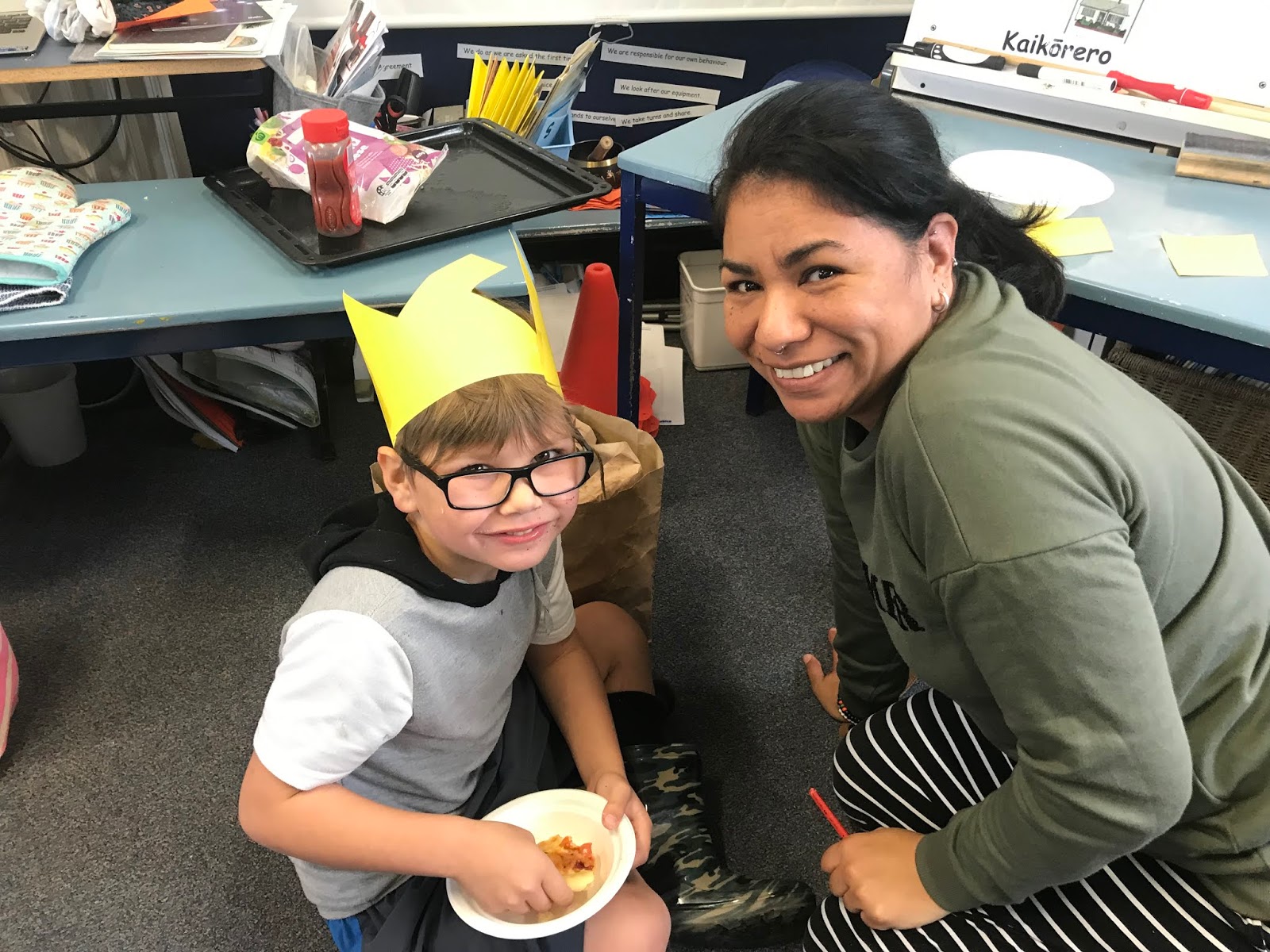
This year, we have celebrated Matariki together with our whānau. We made pizza and had shared kai. Many whanau brought a lot of food for us to share. It was so wonderful to be able to see our whanau, talk to them about their children and enjoy this time where we shared love for each other. We have read the book called "Matariki Breakfast" and from that children have learnt about what people do for Matariki and it is to spend time with the people we love. 

I have asked parents to write down their aspirations for their children on a star shaped piece of paper. This allowed me to know what the parents thoughts and how they want their child to grow into the future. I also thought about including some of these into the report writing highlighting what types of dispositions they have developed over time. 


Parents' aspirations 


Trying out Yolanda programme

After going to Yolanda's training. I really wanted this to be my inquiry to see how effective it will be for me and the children.
As I was waiting for the resources to arrive, I have found a good site for pictures with alphabets. I cut out just pictures to use for the Stage 2 programme.
I have gone through Yolanda's video and wrote down some steps of the Stage 2 and Stage 4 so that it will be easy for me to read as I go through the steps with the children.
Stage 1 and 2 
Stage 4 

So far I have been trying the stage 2 with the whole class and it is working really great. With my target children for the inquiry, I see them every week to see how much they have retained the letter sound knowledge.

I do feel that it makes children to feel successful as it is very achievable for the children. I felt that organising and managing the whiteboards/pens/eraser were a bit chaotic in the beginning, but I used Velcro to attach a pen and an eraser for each whiteboard and this seemed to work better so that I am not spending too much time giving out the items in the beginning.

I also feel that in the beginning, I needed the script for me to go through the steps of the Stage 2 properly but now I have done this for the last 2 weeks that I have felt more confident at doing the Yolanda programme.

Setting up maths success 2022

 Explore the links on the first page  NZ maths have problem solving part  Oral language driving the math  There are different ways to explor...