Thursday, August 27, 2020
Teaching Science and its Capabilities
Thursday, August 20, 2020
Altogether Autism PL session
What is Autism?
Life long condition, born with Autism, diagnosed at possibly 3, provide strategies does not have cure. Experiencing the world in a different way.
ASD: Autism Spectrum Disorder
Disorder: negative
Takiwātanga: Maori way of explaining
In my/his/her own time and space, positive maori view about Autism.
Te Reo Hāpai: book written by Nā keri Opai
Characteristics (Social communication, interaction, restriction/repetitive thinking, behaviour, Sensory)
Don't really way high functioning/low functioning, more like on a spectrum
uses levels 1-3
We don't call it Aspergers, all under Autism. Depending who is diagnosing and what manual they are using.
Girls- they mask it and they are diagnosed later than boys. Girls tend to imitate others' play.
Around the teenage years, they can't mask it later.
Focus on the strengths
Executive Functioning
Help to be organised, plan, remember instructions, understand complex or abstract concepts, deal with change. Working memory
Thursday, July 16, 2020
Writing through play 2
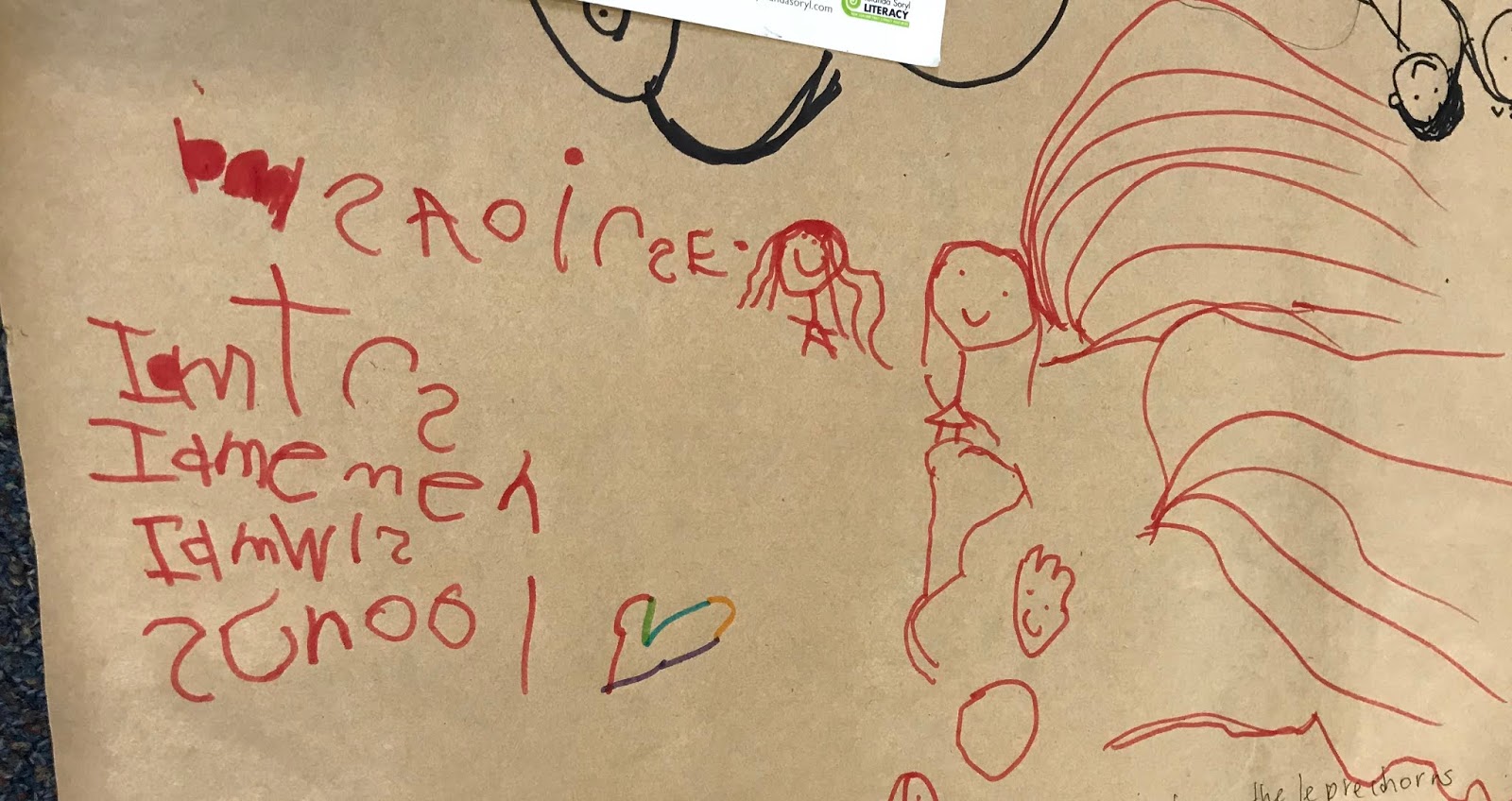
I have been doing shared writing as I see children's interests emerge in our classrooms, and incorporating their interests in shared writing. For example, writing signs for doctor's office that children were creating in family corner, writing letters to fairies, and writing a list.
I also feel that by involving in children's play, I actually see where children are at in terms of writing more than when I was just writing at the jellybean table. I agree with Stacy as she talked about some children feeling really nervous about coming to write at the table and feeling fearful about writing.
I have been recording where children are at and what they are interested in writing every week in Term 2 and I can definitely see that children are progressing even though the steps can be very small. I like that I see them as individuals and that I am supporting their individual needs in writing.
Also recognising and talking about what writing looks like in the classroom really helped in the early on. Like little scribbles and inventive symbols are a part of writing and this really enhanced children's understanding about what writing can look like.
One of the main practice I did was involving children in writing for a fairy. Many children were really interested in writing to the fairies and had questions for them. One of the children made a mailbox for the fairies and that was a way to communicate our ideas to the fairies. I would write the replies back to the children and they were so excited to hear from the fairy Rose. I loved it as there was a purpose for writing and it was really meaningful for the children. I think this was hugely important for the children to understand that there was a reason for writing and there was an audience.
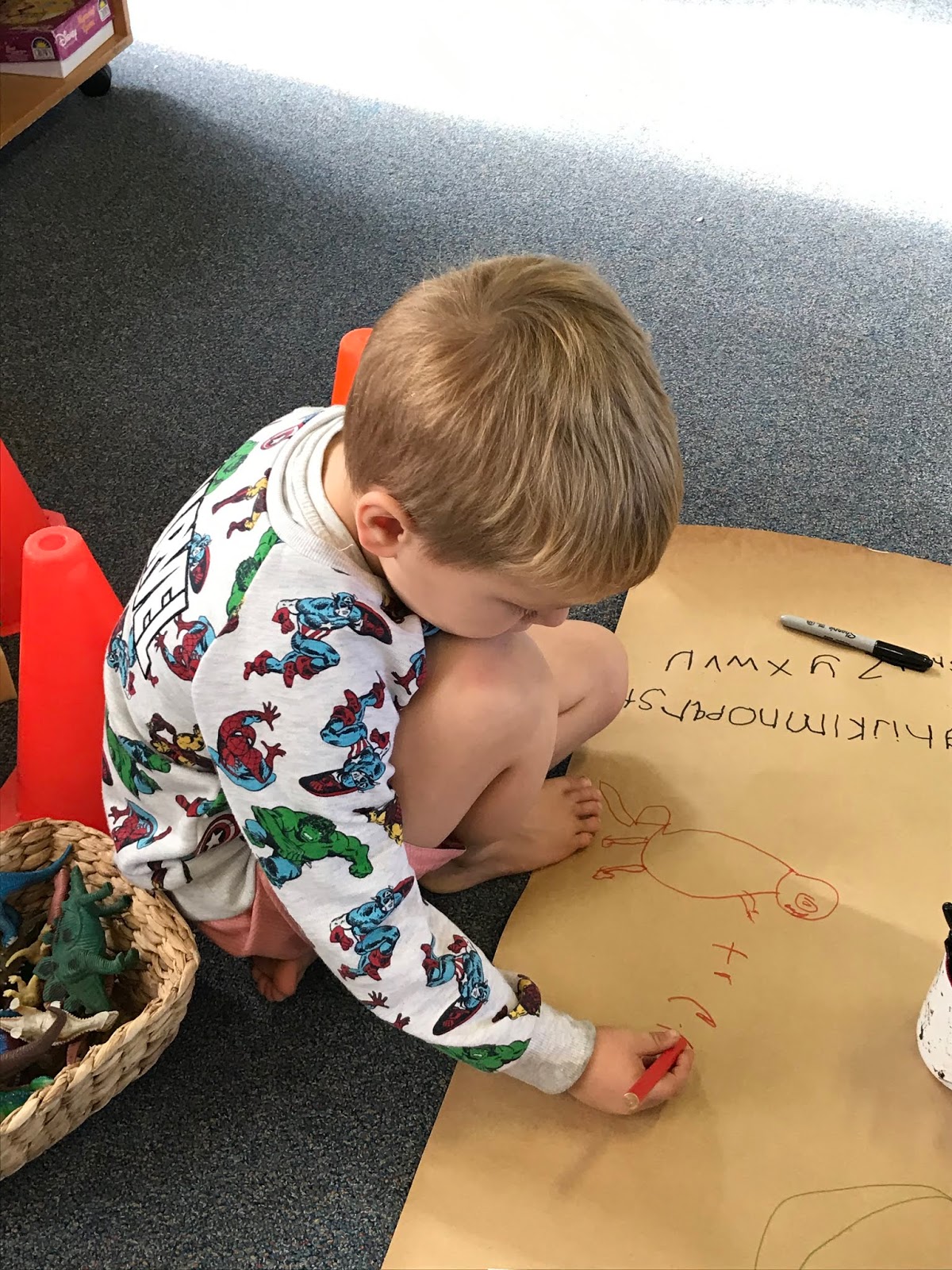
For all of the children in my target group, writing through play was a fantastic practice as I took notice of their interests and wrote together alongside them. 2 boys were very interested in dinosaurs, and they were interested in drawing pictures of dinosaurs and writing stories about them. 1 girl was very interested in writing letters to the fairies and this was a great way for her to know the purpose for writing as she was a very reluctant writer before and often was afraid to make mistakes.
Tuesday, June 9, 2020
PL with Cathy
whole language model- not explicit- phonological awareness stage- words can be taken apart and put together- auditory
This isnt taught but learnt in the environment (traffic noise, animal sounds)
Rhyming words- nursery rhyme
phonemic awareness- hearing one sound
Language rich: language that they are hearing and books that they are exposed
Language poor
Speaking and listening skills through play based environment
Science: Looking, noticing change, when you read, you must look
Subtle difference p, d, b
Decoding stage Stage 1 6-7 years
Direct and explicit teaching
They need to have the sounds, know the symbols and sounds
Decoding teaches rules
Good readers decode, process prints
Poor readers guess
Visual perception going, getting children to point to words
Create spelling lists on the wall
Reading age 10, Burt 7, Sch 7
Skilled readers can read words in isolation,
Burt is a decoding exercise
Stage 2 Fluency
Good reader is a fluent reader, expressive reader
Decoding is a stage
Passed the decoding brain to a fluency brain
Practice- reading
Create a fluency box (known texts)
Perfect practice makes perfect
Hearing himself/herself
Stage 3 REading to learn
8-14
Read to gain information
Developing vocab
Sunday, May 31, 2020
Writing in Play
At the moment I have a group of children who have good understanding about letter sounds and can write a sentence. Others are still in the process of developing these or who do not have letter sounds yet. I think it is so important to understand where children are in terms of their development and provide developmentally appropriate practice accordingly.
What I have been doing with the children are providing writing opportunities during their play. I go into their play and talk about what we can write about while they are playing. We have made signs for their shops/house, name tag, writing a story about their play, and also talking about how our writing looks like. Mark making is a part of writing and since I started talking about this, the more children are doing mark making and are not afraid to do so.
Here are some examples of their writing
I have been taking photos of writing and documenting in my writing recording doc so that I can see a progress when they move onto the next developmental stage.
Thursday, May 14, 2020
Wibinar on Wellbeing
Developing self-regulation
Social skills opportunity to develop social skills through online learning
Building on strengths
Re establishing routines
Stresses are caused at home - depressions, family violence
Collective resilience: community of whaanau
Preserving tikanga while protecting health
Whakamana
What did you learn about yourself? What is one thing that you did to look after each other in your family?
Culture, Identity
Opportunity to speak te reo, cook, bake
Leading up to Matariki
Time to reflect, celebrate and come together
Ease back into things
Listen more than we speak
Feeling safe, cared for and loved
Classroom environment: hands on activity, have fun, positive and active
Connection and relationships
Ready to adapt to change
Perspective of being Patient and Gentle
Listening carefully to the children
Reconnecting
Diverse needs of everyone
Pacifica family
Strength based and solution focused
What we have gained from the lockdown
Whare tapa wha, Taha tinana
Taha wairua: to appreciate the small things, to be grateful and show gratitude
Hinegaro: slowing down
Whaanau: to be with the family and to reconnect
How we can take this learning and time to school: looking at the value that was gained at home
More breaks and kai time
Look at what we did online together
Shared experience- conversation starter
Keep building and maintaining
Listen to the children
Children can co-construct their day
We had a routine before the lock down, but what can it look like? what are we going to change?
Use Seeawa as a way to communicate to their families
Tuesday, May 12, 2020
At the heart of Te Rito toi
Te Rito Toi
Disaster outreach, role of school and disaster recovery
Not just about doing on the first day, before going back
Thinking about the needs of the team
1 How are we going to support each other
What was good and what was bad?
2 what we need to do before students come back?
They need to see things that are familiar
Have a sense that they can connect to
Focus is not about catching up with lost work
Primary focus is the children's well-being
They need to feel safe, cared for and love.
"School is a safe place."
Not about the academic but building relationships, strengthening them
Classrooms have to be fun!
Pedagogy of love and care article
Learning happens in a range of ways, talking to each other, getting to know each other, developing a sense of belonging,
Talk about what they did during online learning, what is the learning here?
Be very gentle about children who show anxiety
Through the arts to express their feelings
Singing together, to dance, to have fun
When they are busy with hands, questions are going to be raised
Lower the expectations of yourself
Carol's Bear books
Book 1
Book 2
Book 3
To get to the learning in the most effective way
Engage with the community, finding a way to reengage with others
Physical difficulties as we wont be able to give hugs etc..
Other parts of the curriculum that are important
We don't have to bounce back but leap forward
Wellbeing
The Arts
Ways of being
Future that we embrace
Nga toi Maori Arts
Staff wellbeing
-Noticing
-Change of behaviour
- Safe place to talk
-Don't judge others as we dont know what goes on in their lives
School days do not have to run exactly to the routines, more flexibilities would be great
Connecting to the families and how can we do this?
Multilingual communities
Setting up maths success 2022
Explore the links on the first page NZ maths have problem solving part Oral language driving the math There are different ways to explor...
-
When we went to the Yolanda phonics course, she talked about a few books that might be helpful to understand how children develop phonologic...
-
Article by Core Education Engaging junior learners and whānau at home
-
Since I have attended the webinar for writing through play, there has been a great change in children's attitudes towards writing. I fee...